Warum:
Wie:
Was:
Der Aufbau des Dokumentes und die Nutzung von Formatvorlagen ist bereits weiter oben erläutert (vgl. Dudenredaktion, 2020).
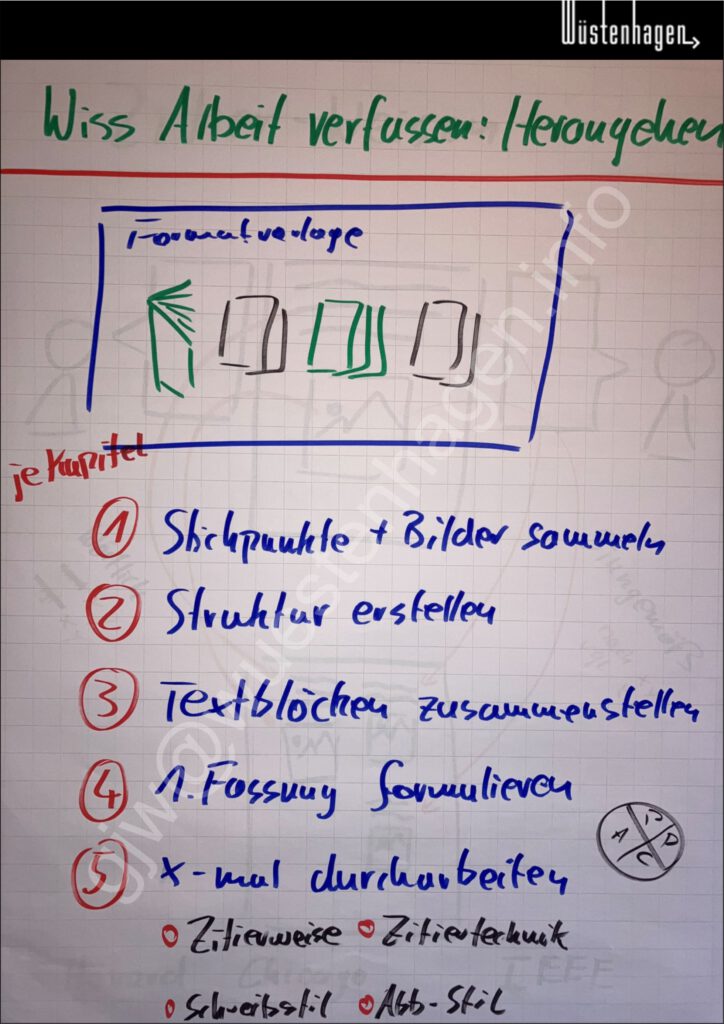
Es gibt wieder zahlreiche Möglichkeiten, das eigentliche Verfassen und Zusammenstellen der wissenschaftlichen Arbeit durchzuführen. Ein mögliches Herangehen wäre:
Beim Verfassen der Arbeit sollten die Richtlinien, Vorgaben und Vorstellungen der prüfenden Organisationen und Personen berücksichtigt werden. Im Rahmen dieser Richtlinien gibt es immer Interpretationsspielraum. Hier ist wichtig, innerhalb der Arbeit durchgängig einheitlich zu arbeiten (vgl. Seidel, 2018).
Why:
How:
What:
The structure of the document and the use of format templates has already been explained above (see Dudenredaktion, 2020).
There are again numerous ways to actually write and compile the academic work. One possible approach would be:
For each element of the work (title page, chapters, etc.), gather initial bullet points and sketches (see Bortz and Döring, 2006).
Give the bullet points and sketches a structure and supplement them with missing points (see Seidel, 2018).
Add the first text blocks and excerpts to the bullet points… in this context, decide on citation methods and techniques (see Hart, 1998).
Go through everything for the first time and create the first draft… better written quickly than focusing on small details… in this context, develop/follow an initial style of writing and illustrating (see Osborn, 1963).
Carefully work through and proofread the draft and have it read (see Bortz and Döring, 2006).
When writing the paper, the guidelines, requirements, and expectations of the examining organizations and individuals should be taken into account. Within these guidelines, there is always room for interpretation. It is important to work consistently throughout the paper (see Seidel, 2018).