Wissensbaustein@GJW / Knowledge-Module@GJW

Six-Sigma & Design for Six-SigmaWissenschaftliches Arbeiten/Scientific Work

DE

Stichprobengröße festlegen

Warum:

Wie:

Was:

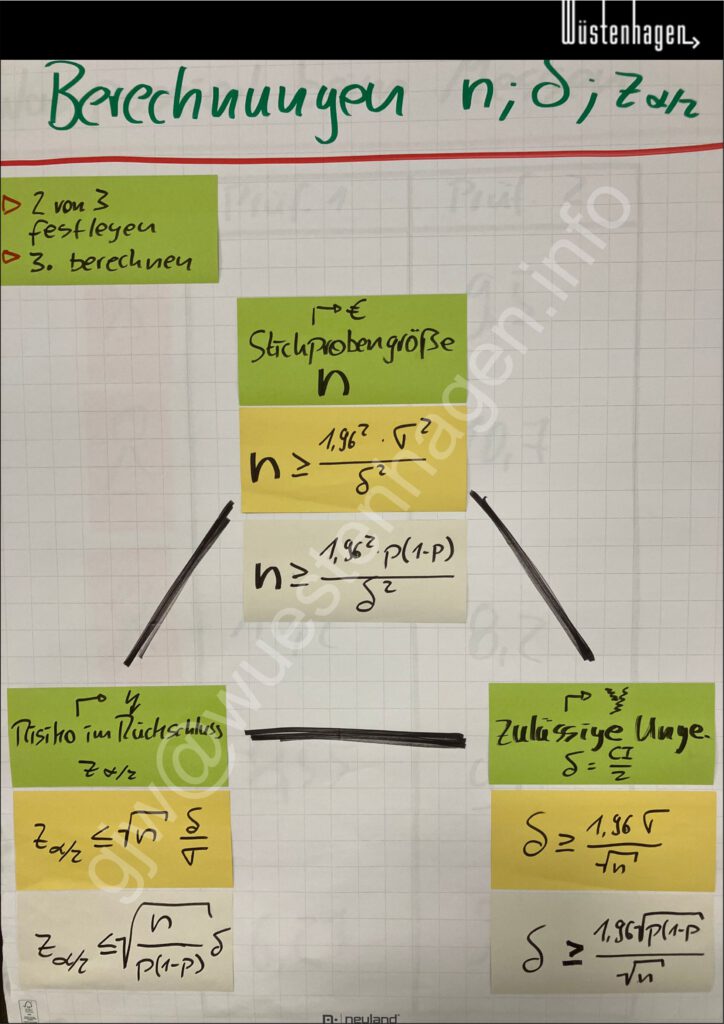
Um zwischen den drei Größen die geeignete Balance zu finden, können für stetige und diskrete Daten entsprechende Berechnungsformeln und deren Umformungen genutzt werden (vgl. Bortz und Döring, 2006).

  • Zuerst werden 2 der 3 Größen festgelegt.
  • Anschließend kann die dritte Größe berechnet werden (vgl. Lütkepohl, 2005).

Falls dieser Weg nicht beschritten werden soll, bietet die Praxis der Statistik folgende Faustformeln:

  • Sollen Mittelwerte verglichen werden, sollte die Stichprobe mindestens 5 Stück umfassen (vgl. Bortz und Döring, 2006).
  • Sollen Standardabweichungen verglichen werden, sollte die Stichprobe mindestens 25 Stück umfassen (vgl. Bortz und Döring, 2006).
  • Sollen Häufigkeiten verglichen werden, sollte die Stichprobe mindestens 50 Stück umfassen (vgl. Field, 2013).
  • Sollen Regressionen durchgeführt werden, sollte die Stichprobe mindestens 25 Stück umfassen (vgl. Field, 2013).

EN

Determine sample size

Why:

How:

What:

To find the appropriate balance between the three variables, corresponding calculation formulas and their transformations can be used for continuous and discrete data (see Bortz and Döring, 2006).

  • First, two of the three variables are set.
  • Then, the third variable can be calculated (see Lütkepohl, 2005).

If this approach is not followed, statistical practice offers the following rule-of-thumb formulas:
  • If means are to be compared, the sample should consist of at least 5 items (see Bortz and Döring, 2006).
  • If standard deviations are to be compared, the sample should consist of at least 25 items (see Bortz and Döring, 2006).
  • If frequencies are to be compared, the sample should consist of at least 50 items (see Field, 2013).
  • If regressions are to be performed, the sample should consist of at least 25 items (see Field, 2013).